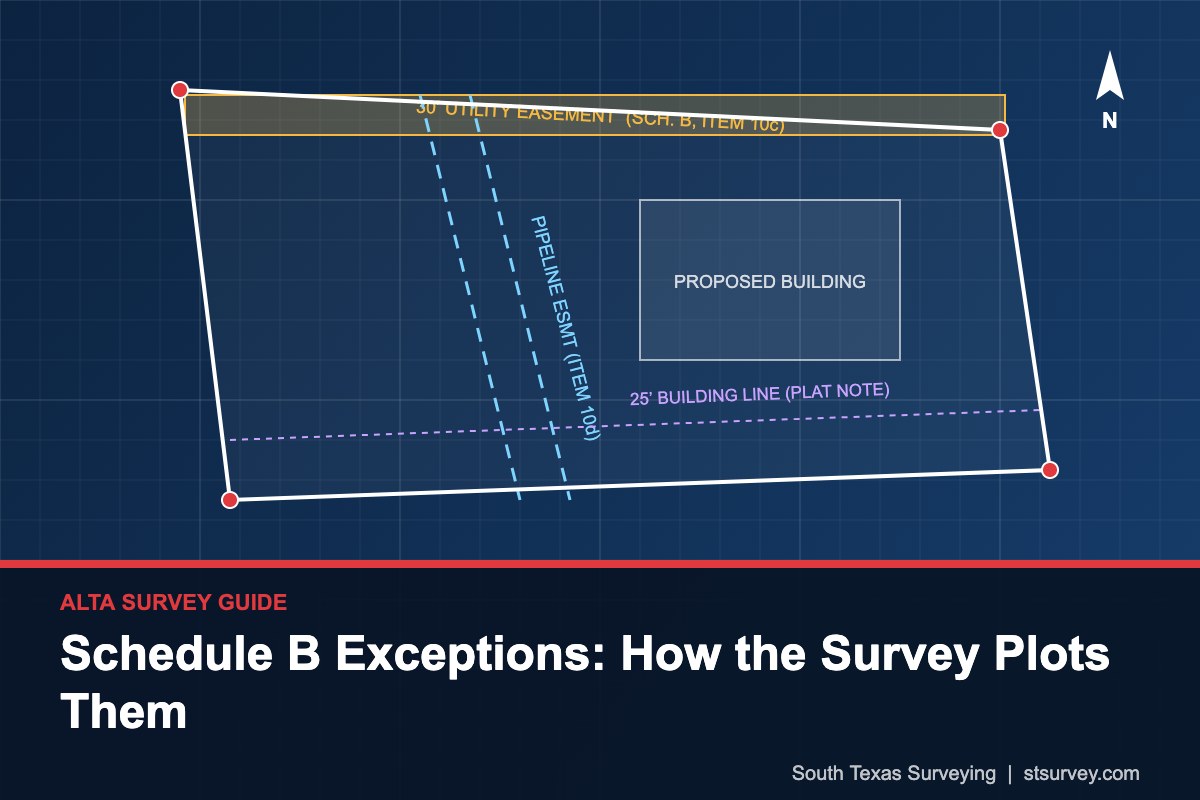
Schedule B Exceptions on a Commercial Title Commitment: How the Survey Plots Them
Reading Schedule B on a Commercial Title Commitment? Here's How the Survey Plots It
The title commitment lands in your inbox two weeks into due diligence. Schedule B runs four pages: pipeline easements from the 1960s, a utility easement "as described in Volume 412, Page 88," a building line from an old plat, and a blanket right-of-way that doesn't say where it is. Your lender wants to know which of these touch the site. Your attorney wants the same thing. The answer lives on the survey.
Quick answer: On a commercial deal, the surveyor reviews each recorded Schedule B exception, plots the ones that can be located on the ground, and notes the ones that can't. That turns a list of recording references into a drawing your attorney, lender, and engineer can actually use.
What Schedule B Actually Is
A title commitment lists the matters the title company will not insure against unless they are removed or resolved. Schedule B exceptions are the recorded items that stay with the land: easements, restrictions, plats, leases, and similar documents. Some are routine. Some can kill a building pad.
The problem is that the commitment only gives a reference number. It doesn't tell you whether a 30-foot pipeline easement crosses the middle of your tract or sits along the back fence. That's the survey's job.
How the Survey Handles Each Exception
On an ALTA/NSPS Land Title Survey, the surveyor works from the title commitment and the recorded documents. Each exception generally ends up in one of a few buckets:
Plotted. The document describes a location precisely enough to draw it, so it's shown on the drawing with its width and recording information.
Affects, but not plottable. It touches the property, but the description is too vague to draw. A "blanket" easement is a common example.
Does not affect. The document covers nearby land, not your tract.
Those notes are what your attorney uses to decide what to object to and what to accept.
The current national standard matters here. The 2026 ALTA/NSPS Land Title Survey Standards took effect February 23, 2026, and cover fieldwork, plat content, Table A optional items, and certification. If your survey was ordered after that date, the order should reference the 2026 standards.
Exceptions That Deserve a Closer Look
Certain Schedule B items show up again and again on Texas commercial land:
Pipeline easements. Common across the Houston region. Width, location, and any restrictions on building or paving over them affect your site plan.
Utility easements. Electric, water, and sewer easements may limit where the building, detention, or parking can go.
Plat notes and building lines. A recorded plat may set setbacks, access limits, or drainage requirements that the deed alone doesn't show.
Restrictive covenants. Use restrictions can matter more than the line work. The survey can show plottable parts. Your attorney reads the rest.
Access and cross-access agreements. These affect how customers and trucks get in and out.
Blanket Easements Are the Tricky Ones
An old easement might say a pipeline company can lay lines "across" a tract without giving a width or a route. The surveyor can't invent a location that the document doesn't give. What they can do is note it as affecting but not plottable, and show any visible evidence on the ground, such as markers, vents, or cleared corridors.
That note gives your attorney something to work with. Common next steps include asking the easement holder for a location letter or a partial release. Those are legal decisions, so bring them to counsel.
Why This Changes the Deal
A plotted exception can change your numbers fast. If a utility easement takes a strip along the frontage, that strip may not be usable for the building, signage, or parking you planned. That's the difference between gross acres and buildable acres, and it's often discovered only when the exceptions are drawn.
It also changes your timeline. Most purchase contracts give the buyer a set period to object after receiving the title commitment and survey. If the survey arrives late, that window gets tight.
How to Get Schedule B Plotted Without Delays
Send the commitment early. The surveyor needs the current commitment and copies of the recorded documents, not just the commitment.
Flag lender requirements. If the lender has a Table A list or specific certification language, send it with the order.
Share the site plan concept. Knowing where you want the building helps the surveyor point out conflicts early.
Ask for updates if the commitment changes. A revised commitment with new exceptions may need a revised survey.
Who Reviews the Plotted Exceptions
Once the survey arrives, several people read it for different reasons:
Your attorney compares the survey notes to the title commitment and decides what to object to before the deadline.
The title company uses the survey to decide what coverage it can issue and whether any survey-related exceptions can be modified.
The lender's counsel checks that easements and restrictions don't interfere with the collateral.
Your civil engineer looks at where easements fall relative to the planned building, parking, and detention.
Sending the survey to all four at once, with the title commitment attached, keeps the review on schedule. If any of them has questions about how an exception was handled, the surveyor can explain the note or, if new documents surface, update the drawing.
FAQ
Does every survey plot Schedule B exceptions?
Not automatically. ALTA/NSPS surveys address the title commitment as part of the standard. On other survey types, ask for it in the scope. For commercial closings, it's usually worth it.
What if an exception says "not plottable"?
It means the recorded description isn't specific enough to draw. It doesn't mean it doesn't matter. Talk to your attorney about how to handle it before the objection deadline.
Can the survey remove an exception?
The survey itself doesn't remove anything, but it gives your attorney and title company the information needed to negotiate, clarify, or seek a release. See our guides on Category 1A land title surveys and boundary surveys for related scopes.
This article is general information, not legal advice. Your attorney should review the title commitment and objection deadlines.
Buying commercial land in Texas and staring at a long Schedule B? Send South Texas Surveying the title commitment, the recorded exception documents, the property address or legal description, your lender's survey requirements, and your due diligence dates. Our team will tell you what can be plotted and how fast. Request a commercial survey quote or contact our office.

