Surveying Texas Since 1980 Family Owned, Customer Devoted | Firm #10045400 | 281-556-6918

See Our Latest Blogs
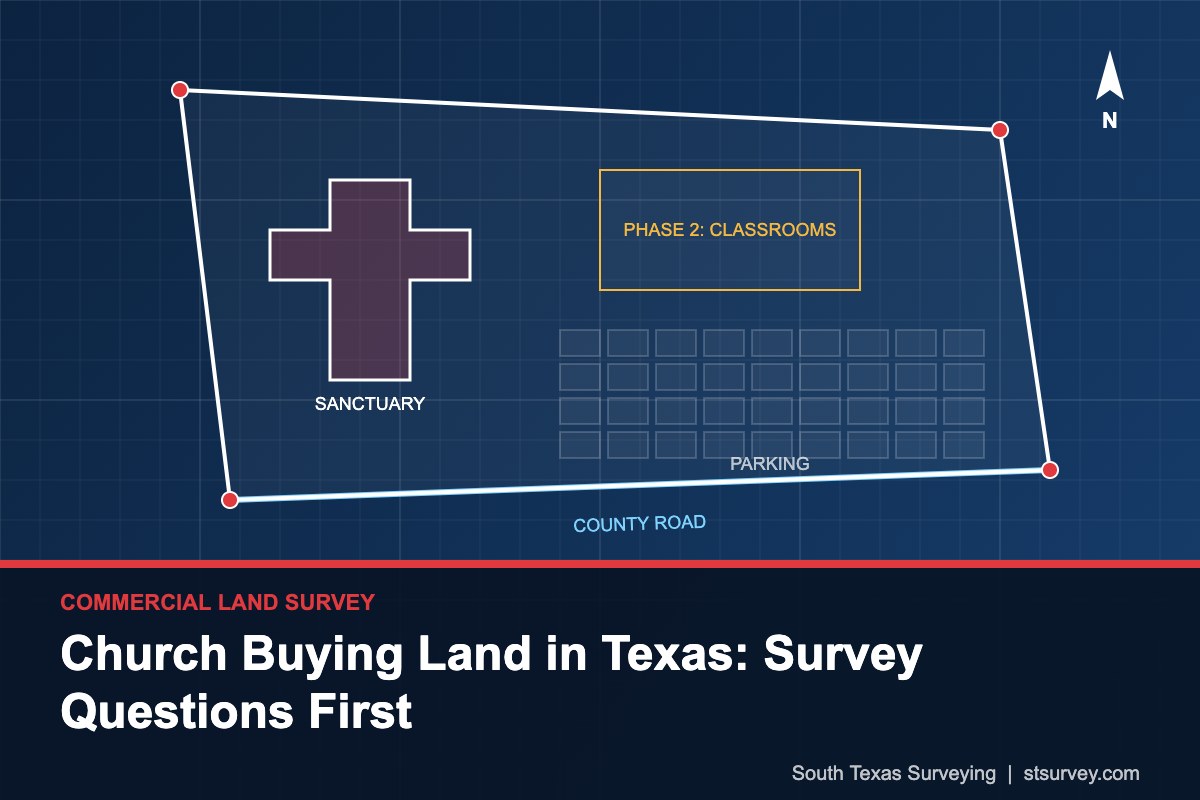
Church Buying Land in Texas: Survey Questions to Settle Before You Close
Church Buying Land in Texas? Survey Questions to Settle Before You Close
The building committee has found the spot: eight acres on a county road, room for a sanctuary, parking, and maybe a school down the road. The congregation has been raising money for three years. Everyone is excited, and the seller wants an answer. Before anyone signs, someone needs to know whether the land will actually hold what the church plans to build.
Quick answer: A church or ministry buying land should treat it like any commercial acquisition. Get a survey that shows the true boundary, recorded easements, access, floodplain, and the ground's shape, then compare that against the long-term campus plan, not just the first building.
Why Church Land Purchases Are Different
Most churches buy land once in a generation. The people making the decision are volunteers with day jobs, and the purchase often depends on donations already given. That raises the stakes. A problem found after closing is paid for by the congregation.
Church campuses also grow in phases. The first building may be a multipurpose hall. Later come a sanctuary, classrooms, a gym, and more parking. A tract that works for phase one may not work for the full plan.
What the Survey Should Show
The true boundary and acreage. Listing acreage and appraisal district maps are estimates. A boundary survey shows what the deed actually describes.
Recorded easements. Pipelines, power lines, and drainage easements can cut through the middle of a tract and limit where buildings and parking can go.
Legal access. Frontage on a public road, or a recorded access easement if the tract is landlocked.
Flood zones. Floodplain on part of the tract may affect where you build and what insurance costs.
Topography. A topographic survey shows elevations and drainage patterns your engineer needs to design detention and grading.
Parking Usually Drives the Site Plan
Churches have a peak problem. On Sunday morning, every space is full. Local parking rules are often tied to seating capacity, so the number of spaces can drive how much of the land gets paved. Pavement adds runoff, and runoff can mean detention, which takes more land.
That chain reaction is why the survey matters early. Once your engineer can see the real boundary, easements, and elevations, they can estimate how much of the tract is left for buildings after parking and detention. That usable number is the one the committee should be comparing between sites.
Gifted and Donated Land
Sometimes a member donates land. That's generous, but it doesn't remove the need for due diligence. Donated tracts are often older family land with old deeds, fences that don't follow the boundary, and informal access across a neighbor's property. A survey sorts out what the church is actually receiving before the deed is recorded.
Questions for the Building Committee
What is the full campus plan for the next 20 years, not just the first building?
Does the tract have legal road access, and where would the main entrance go?
Are there easements, pipelines, or power lines crossing the land?
Is any of the land in a flood zone?
Is the property inside city limits, in a city's ETJ, or in the unincorporated county? That affects who reviews platting and permits.
Does the title commitment list exceptions the survey needs to plot?
When to Call the Surveyor
The best time is before the purchase contract's feasibility period starts running, or at the very start of it. That gives the committee time to see the survey, share it with the architect or engineer, and decide before the money is at risk. Waiting until the week before closing leaves no room to negotiate if something turns up.
If the church has a lender, ask what kind of survey they require. Many lenders want an ALTA/NSPS survey for commercial-style loans. If not, a Category 1A land title survey may fit.
Comparing Two or Three Candidate Sites
Many building committees end up choosing between a few properties. Listing prices and acreage make that comparison look simple, but the numbers that matter are usually hidden until the land is surveyed. A 10-acre tract with a pipeline easement through the middle and a floodplain along the back may hold less church than a clean 7-acre tract with good frontage.
When the committee is down to finalists, it can make sense to ask the surveyor for a quick review of each site's recorded easements, access, and flood zone before committing to full survey work on one. That early look won't replace a full survey, but it helps the committee compare usable land rather than advertised acreage.
Questions to bring to that comparison
How much of each tract is outside easements, floodplain, and required setbacks?
Which site gives the best main entrance location for Sunday traffic?
Which site leaves room for the second and third phases of the campus plan?
Where would detention likely go on each property?
Bringing those answers to the congregation makes the final vote easier to explain and defend.
FAQ
Does a church need a commercial survey or a residential one?
Church land is a non-residential use, and the scope usually looks like a commercial survey: boundary, easements, access, improvements, and often topography for design.
Can we use the seller's old survey?
Maybe as a starting point. Check its date, what it shows, and whether your title company and lender will accept it. Fences, buildings, and easements may have changed.
How long does a survey take on rural acreage?
It depends on tract size, access, vegetation, records research, and weather. Ask for a realistic window before setting your feasibility deadline.
This article is general information, not legal advice. Have an attorney review the contract and title commitment.
Is your church or ministry looking at land in the Houston area or elsewhere in Texas? Send South Texas Surveying the address or legal description, the approximate acreage, your campus plans, any lender or title requirements, and your contract dates. We'll recommend a scope that fits the purchase. Request a survey quote or contact our team.

Contact Us
Email: [email protected]
Office Address: 11281 Richmond Ave
BLDG J, Suite 101,
Houston, TX 77082
Office Hours: Mon – Fri 8:00am – 5:00pm
Office Phone Number: 281-556-6918
11281 Richmond Ave
BLDG J, Suite 101,
Houston, TX 77082
Firm Number: 10045400
Resources
© Copyright 2026 South Texas Surveying Associates